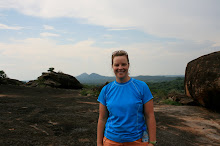
These are individual foods or a complete meal that I am craving while in Uganda. I am listing them by the day that I was craving them.
Sunday, June 28: BLT with home grown tomatoes and Mama’s homemade bread. Served with a dill pickle spear and salt and vinegar potato chips.
Thursday, July 2: Cheeseburger with lettuce, onions, pickles, and mustard
Saturday, July 4: Pimento cheese from The Fresh Market
Wednesday, July 8: Big green salad with LOTS of fresh veggies, beaufort stew
Monday, June 29, 2009

Rhino Sanctuary- Saturday, June 27
We traveled to the Rhino Sanctuary today. It was about a three hour trip southwest in a mutatu. We stopped twice: once for a short call and once for the driver to stretch and for us to be harassed by street vendors.
After Idi Amin was overthrown, many people came in and hunted the rhinos to extinction: either for a trophy or for their horns, which are highly coveted in parts of Asia. Several joint organizations have come together to create this sanctuary in order to repopulate the area with black and white rhinos. They hope to provide a place where the rhinos can be safe, have babies and then be released back into the wild. There are currently 6 rhinos at the sanctuary, and they are protected by guards 24 hours a day, 7 days a week, 365 days a year. It is a necessary thing, but I find it a little ridiculous that we live in a world where rhinos have to be protected ALL the time.
After unloading our stuff, we went and had lunch before the rhino walk. The lunch took forever to come out (not shocking in the least), but it was very yummy. It was spaghetti with meat and a little cheese on it. We then changed into clothing for walking through the bush. Once we were ready to go, we got back in the mutatus and drove for about 20 minutes through the bush. It was a very skinny “road” and very bumpy. As we were driving, we saw small deer, guinea fowl and lots of birds. We finally stopped and split into two groups. Our group was first, so we walked another 10 minutes through the bush. The guards stopped us, I looked up and we were about 20 feet from 3 enormous rhinos! We saw Taleo, the alpha male, and Kori and Bella, two females. The guard said that Taleo weighs about 250 tons; he was enormous! They were lying down when we arrived. We were able to get to about 10 feet from them, and the guards stopped us. To stand 10 feet away from rhinos without any sort of fencing was incredible. It was yet another moment that I thought, “I am in Africa standing 10 feet from rhinos! It doesn’t get any better than this.” We hung around for about 45 minutes just watching them, trying to surprise each other with grass blades and laughing at each other. We finally began walking back to the mutatus and drove back to the lodges.
For dinner, we had another delicious meal. It consisted of chicken that was actually edible. Normally, the chicken has been really tough. We theorize that it is because the chickens here are mobile; we see them walking around the town all of the time. When you compare them to American chickens who sit there all day, you could understand why the chicken here would be much tougher. It is to the point that I will not eat the chicken here anymore because I simply cannot chew it up.
After dinner, we learned to play Texas Hold ‘Em. We were trying to play with bottle caps, but we did not have enough. One of the people who works at the Rhino Sanctuary had actual poker chips, so we were able to actually bet and practice. It was fun to be able to relax and play. Good times…
Driving back was a lesson in how to remain calm in the event of possible death. Our driver seemed very intent on driving back as quickly as possible, and there were several “almost” head on collisions between us and big trucks. Add a rainstorm to this, and you can imagine my concern about my well being. I guess I should put more faith in the mutatu drivers since they have been doing it a lot longer, but it is still something to get used to. As we arrived back in Gulu, it was culture shock coming back. The town seemed so bustling and loud, and after being in a very quiet sanctuary, it was hard to come back to. When I arrived to Gulu from Kampala, I thought the city was so quiet and small. However that was not the case returning to it today. It’s amazing how your perspective can change so quickly through new experiences.
After Idi Amin was overthrown, many people came in and hunted the rhinos to extinction: either for a trophy or for their horns, which are highly coveted in parts of Asia. Several joint organizations have come together to create this sanctuary in order to repopulate the area with black and white rhinos. They hope to provide a place where the rhinos can be safe, have babies and then be released back into the wild. There are currently 6 rhinos at the sanctuary, and they are protected by guards 24 hours a day, 7 days a week, 365 days a year. It is a necessary thing, but I find it a little ridiculous that we live in a world where rhinos have to be protected ALL the time.
After unloading our stuff, we went and had lunch before the rhino walk. The lunch took forever to come out (not shocking in the least), but it was very yummy. It was spaghetti with meat and a little cheese on it. We then changed into clothing for walking through the bush. Once we were ready to go, we got back in the mutatus and drove for about 20 minutes through the bush. It was a very skinny “road” and very bumpy. As we were driving, we saw small deer, guinea fowl and lots of birds. We finally stopped and split into two groups. Our group was first, so we walked another 10 minutes through the bush. The guards stopped us, I looked up and we were about 20 feet from 3 enormous rhinos! We saw Taleo, the alpha male, and Kori and Bella, two females. The guard said that Taleo weighs about 250 tons; he was enormous! They were lying down when we arrived. We were able to get to about 10 feet from them, and the guards stopped us. To stand 10 feet away from rhinos without any sort of fencing was incredible. It was yet another moment that I thought, “I am in Africa standing 10 feet from rhinos! It doesn’t get any better than this.” We hung around for about 45 minutes just watching them, trying to surprise each other with grass blades and laughing at each other. We finally began walking back to the mutatus and drove back to the lodges.
For dinner, we had another delicious meal. It consisted of chicken that was actually edible. Normally, the chicken has been really tough. We theorize that it is because the chickens here are mobile; we see them walking around the town all of the time. When you compare them to American chickens who sit there all day, you could understand why the chicken here would be much tougher. It is to the point that I will not eat the chicken here anymore because I simply cannot chew it up.
After dinner, we learned to play Texas Hold ‘Em. We were trying to play with bottle caps, but we did not have enough. One of the people who works at the Rhino Sanctuary had actual poker chips, so we were able to actually bet and practice. It was fun to be able to relax and play. Good times…
Driving back was a lesson in how to remain calm in the event of possible death. Our driver seemed very intent on driving back as quickly as possible, and there were several “almost” head on collisions between us and big trucks. Add a rainstorm to this, and you can imagine my concern about my well being. I guess I should put more faith in the mutatu drivers since they have been doing it a lot longer, but it is still something to get used to. As we arrived back in Gulu, it was culture shock coming back. The town seemed so bustling and loud, and after being in a very quiet sanctuary, it was hard to come back to. When I arrived to Gulu from Kampala, I thought the city was so quiet and small. However that was not the case returning to it today. It’s amazing how your perspective can change so quickly through new experiences.
An English teacher teaches about the UN and ICC
I had the best experience today at SSB. Okello P’Layeng asked me to speak to his General Paper class which meets on Friday from 2:40-4:00 pm. This is a class for S5 and S6 students, and I think the purpose of it is to create discussion about different subjects. Okello told me he wanted me to speak on the United Nations and the ICC. Needless to say, I was a little concerned about this as I have a very limited knowledge of both entities. However, I really wanted a chance to get involved with the students, so I said okay.
I spent 1½ hours yesterday at Café Larem on the Internet researching the UN and ICC. I asked my fellow members of Group 2 for information and help. I wanted to share the information with the students but do it in a way that was interesting and thought provoking. So I took notes and prepared the lesson that included working in pairs and groups.
I arrived at SSB at 2:00 pm, and Okello P’Layeng was no where to be found. At 2:40, one of the other teachers walked me to the biology lab. It was on this walk that I was told that this class was the S5 and S6 streams combined, which meant that could be almost 200 students in the class. They hold the class in the Biology Lab because it is so big. Okello P’Layeng never showed up, but one of the student teachers named Patrick sat in there with me. I think he sat in there more to hear the information than to help with the class.
There were about 75 students in the class, and they were all taller than me by a lot. These young men (because they are no longer boys) were very intimidating, but I felt up to the challenge. We started out with me having them brainstorm what they knew about the United Nations in pairs. Then I had 6 volunteers write what they had thought of on the chalkboard. Mostly what they wrote was very basic information including when it began and what its purpose was. They seemed to not know the specifics of the Security Council, nor did they know anything about the ICC (International Criminal Court). We talked about the 5 permanent member states and how they came to be permanent members and then the 10 rotating member states; I asked them to name one of the rotating member states, and they could not. I then wrote “Uganda” on the board and asked them if they had ever heard of this country. They laughed very loudly, and I explained that Uganda was currently serving on the Security Council in its two year term. I also discussed the ICC with them, mentioned the two current cases in front of the ICC as well as the fact that the ICC had issued arrest warrants for Joseph Kony and 4 of his top commanders in 2005. Once we had discussed this information, we began the discussion. I wanted to discuss the following questions with this group:
- Is the UN living up to its mission? Why or why not?
- Is the ICC doing enough to capture Joseph Kony?
- What happens if countries do not follow the guidelines set up by the UN?
- What do you think of the veto process in the Security Council? Does it create an effective form of governing?
- Are the UN security forces effective in providing or keeping peace? Should their role change?
These students were amazing. They actually brought up many of these questions for discussion themselves and asked what I thought. I turned it around to them and asked them what they thought. Their answers were so provoking and mature that I forgot I was speaking to the teenagers. They were very opinionated on what should be done by the ICC in connection to Joseph Kony. They definitely felt that the ICC is not doing enough. Those who spoke felt that if the ICC was going to issue arrest warrants, then they should have the UN security forces go in and get him. That discussion then naturally led into the role of the UN security forces as peacekeeping and not “peacemaking.”
We also discussed how they had been affected by this war, and I mentioned the fact that they were born into it and knew nothing else. We also discussed the idea of war, and if a war is occurring, if that means that the rights of those humans no longer becomes a concern. They firmly believe that until Joseph Kony is caught, they are not completely safe. They also felt that Kony will not come out of the bush until there is a new Ugandan president because Kony is scared of Musaveni. They believe that government must change the situation.
We finished the discussion by me saying that I believed that the true method of change was through them. They needed to continue their education and move into jobs where they could influence the change. I ended with the idea that they are the hope of Uganda.
I walked out of this class floating on air. Several students stopped me again to thank me for teaching them. To see 75 teenage boys in a hot classroom engaged in a discussion about the UN was a bright spot in my trip. It was yet another example of the beauty of this country and the hope that permeates through the people. I am so grateful to be witness to it for 6 weeks.
I spent 1½ hours yesterday at Café Larem on the Internet researching the UN and ICC. I asked my fellow members of Group 2 for information and help. I wanted to share the information with the students but do it in a way that was interesting and thought provoking. So I took notes and prepared the lesson that included working in pairs and groups.
I arrived at SSB at 2:00 pm, and Okello P’Layeng was no where to be found. At 2:40, one of the other teachers walked me to the biology lab. It was on this walk that I was told that this class was the S5 and S6 streams combined, which meant that could be almost 200 students in the class. They hold the class in the Biology Lab because it is so big. Okello P’Layeng never showed up, but one of the student teachers named Patrick sat in there with me. I think he sat in there more to hear the information than to help with the class.
There were about 75 students in the class, and they were all taller than me by a lot. These young men (because they are no longer boys) were very intimidating, but I felt up to the challenge. We started out with me having them brainstorm what they knew about the United Nations in pairs. Then I had 6 volunteers write what they had thought of on the chalkboard. Mostly what they wrote was very basic information including when it began and what its purpose was. They seemed to not know the specifics of the Security Council, nor did they know anything about the ICC (International Criminal Court). We talked about the 5 permanent member states and how they came to be permanent members and then the 10 rotating member states; I asked them to name one of the rotating member states, and they could not. I then wrote “Uganda” on the board and asked them if they had ever heard of this country. They laughed very loudly, and I explained that Uganda was currently serving on the Security Council in its two year term. I also discussed the ICC with them, mentioned the two current cases in front of the ICC as well as the fact that the ICC had issued arrest warrants for Joseph Kony and 4 of his top commanders in 2005. Once we had discussed this information, we began the discussion. I wanted to discuss the following questions with this group:
- Is the UN living up to its mission? Why or why not?
- Is the ICC doing enough to capture Joseph Kony?
- What happens if countries do not follow the guidelines set up by the UN?
- What do you think of the veto process in the Security Council? Does it create an effective form of governing?
- Are the UN security forces effective in providing or keeping peace? Should their role change?
These students were amazing. They actually brought up many of these questions for discussion themselves and asked what I thought. I turned it around to them and asked them what they thought. Their answers were so provoking and mature that I forgot I was speaking to the teenagers. They were very opinionated on what should be done by the ICC in connection to Joseph Kony. They definitely felt that the ICC is not doing enough. Those who spoke felt that if the ICC was going to issue arrest warrants, then they should have the UN security forces go in and get him. That discussion then naturally led into the role of the UN security forces as peacekeeping and not “peacemaking.”
We also discussed how they had been affected by this war, and I mentioned the fact that they were born into it and knew nothing else. We also discussed the idea of war, and if a war is occurring, if that means that the rights of those humans no longer becomes a concern. They firmly believe that until Joseph Kony is caught, they are not completely safe. They also felt that Kony will not come out of the bush until there is a new Ugandan president because Kony is scared of Musaveni. They believe that government must change the situation.
We finished the discussion by me saying that I believed that the true method of change was through them. They needed to continue their education and move into jobs where they could influence the change. I ended with the idea that they are the hope of Uganda.
I walked out of this class floating on air. Several students stopped me again to thank me for teaching them. To see 75 teenage boys in a hot classroom engaged in a discussion about the UN was a bright spot in my trip. It was yet another example of the beauty of this country and the hope that permeates through the people. I am so grateful to be witness to it for 6 weeks.
Thursday, June 25, 2009
Random Thoughts
Today (Thursday) I really helped Grace teach Sentence Inversions. I have to say that before this week, I had no idea what sentence inversions were; however after listening to Grace’s lesson, I felt able to create a fun exercise around it. I taught the exercise today to two S4 classes. The first class was a little slower than the 2nd class, but they completed it and seemed to understand the concepts. After teaching the second class, I had about 6 students thank me for teaching them today, and one even said that he really enjoyed the lesson. It made my heart smile. These students are so appreciative of what I have to offer. Grace was also very grateful as she said that I had shown her a new way of getting a concept across. So I am feeling really good right about now.
As I was walking away from Sir Samuel Baker School (SSB), I took a moment to recognize the fact that I am in Africa. It is a breathtakingly beautiful country, and I am so grateful to share my time here and learn with these people. They continue to amaze me every day with their kindness and positive attitudes. If Americans had this same kind of drive and hope, we would live in a very different, and much better, country. I am sure that by the time I leave that I will have taught only a little. However I will have learned so much about character, resilience, and love. I feel truly honored to be in the presence of the Ugandan people.
As I was walking away from Sir Samuel Baker School (SSB), I took a moment to recognize the fact that I am in Africa. It is a breathtakingly beautiful country, and I am so grateful to share my time here and learn with these people. They continue to amaze me every day with their kindness and positive attitudes. If Americans had this same kind of drive and hope, we would live in a very different, and much better, country. I am sure that by the time I leave that I will have taught only a little. However I will have learned so much about character, resilience, and love. I feel truly honored to be in the presence of the Ugandan people.
Living in Gulu
Living in Gulu is a culture shock, but so far, I am handling it pretty well. The roads are terrible; riding on a boda boda is like going through an obstacle course. The driver has to find the smoothest route around pot holes, crevices that are 1-2 feet deep and huge rocks. There are a few paved roads in Gulu, but they are not paved really well. The edges on either side of the road are breaking away and along with the huge potholes makes the paved roads not much of a better option.
The showers are cold, but after my morning runs, it actually feels good and cools me down quicker. The water pressure is so-so, and I am not really sure that I get my hair completely clean. Shaving legs is impossible; I finally just filled a bucket of water and shaved in the courtyard the other day. When using the bathroom, you either make a short call or a long call. A short call is just peeing, and a long call is… well, you can figure it out. We have designated pit latrines for short calls and long calls, which cuts down on the smell. We have become one big happy family in Group 2. There is nothing that does not get talked about.
We have been without electricity for two days. It really is not a big deal as the courtyard is open air and we don’t need light at night. However in terms of charging things, that does put a little damper on it. It’s amazing what you learn to live without. I know when I return that I will be very grateful for toilets that have seats and showers with water pressure.
I am a novelty here. Not only am I white, but I have blond hair. Children love shouting “muno” or “mzungo” as I walk by, and they love to just stare. By the end of this trip, I will have the best self esteem or the thickest skin from being an oddity.
I rode on a bicycle today side saddle, which was very awkward and uncomfortable. Quickly a boda came along, and saved me from this embarrassing situation.
The showers are cold, but after my morning runs, it actually feels good and cools me down quicker. The water pressure is so-so, and I am not really sure that I get my hair completely clean. Shaving legs is impossible; I finally just filled a bucket of water and shaved in the courtyard the other day. When using the bathroom, you either make a short call or a long call. A short call is just peeing, and a long call is… well, you can figure it out. We have designated pit latrines for short calls and long calls, which cuts down on the smell. We have become one big happy family in Group 2. There is nothing that does not get talked about.
We have been without electricity for two days. It really is not a big deal as the courtyard is open air and we don’t need light at night. However in terms of charging things, that does put a little damper on it. It’s amazing what you learn to live without. I know when I return that I will be very grateful for toilets that have seats and showers with water pressure.
I am a novelty here. Not only am I white, but I have blond hair. Children love shouting “muno” or “mzungo” as I walk by, and they love to just stare. By the end of this trip, I will have the best self esteem or the thickest skin from being an oddity.
I rode on a bicycle today side saddle, which was very awkward and uncomfortable. Quickly a boda came along, and saved me from this embarrassing situation.
Beginning of School
We started at our schools on Monday. I am at Sir Samuel Baker Secondary School, which is about a 15 minute boda boda ride out of town. Between the two teachers that I am working with, I have a full schedule, which is good because it will keep me busy. On Monday and Tuesday, I sat and observed. It was so BORING!! Their main teaching method is called “chalk and talk,” which means they stand at the chalkboard and lecture. It explains why this teacher exchange is so important; we are here to share alternative teaching methods that they can then use in their classrooms. That is what the “exchange” is all about. It is an exchange of ideas to help the Gulu educational system.
I have made some observations about education; however, my only perspective at this point is Sir Samuel Baker.
The classroom is very basic: it has a desk attached to a bench that sit 2-4 students and a chalkboard. That is all. Because of the push for math and science, each child gets his/her own textbook to keep in those subjects. However in English, 3 streams (or classes which equals about 120 students) share about 25 books. The students stay in class, and the teachers rotate. The class schedule is set up like a college schedule; classes meet 2-3 times per week for either 40 or 80 minutes. The teachers literally teach to the test (national examination).
Teachers check work by using a red pen. They give a check if the answer is correct; the checks do not mean anything, but the students LOVE them. The only grades that they receive are the midterm and final grade. The students here are so different in terms of behavior. Grace said today that she thought the students were bad; I was shocked and told her that I thought they were great compared to American students. They remain on task, and even when finished, they sit silently or help their classmate. They are sweet, polite, and so interested in learning. The classes get smaller as the streams get higher; some students stop coming, some have other obligations, etc.
The bell that rings sounds like a dinner bell, and it is only a suggestion. Teachers don’t necessarily begin or end class on time. If a student is late, he knocks on the door, and asks “Madam (or Sir), may I come in?”
The student’s education is truly up to him/her. They are responsible for getting and learning the material. If they do not complete the work or pass the test, the teacher is not necessarily criticized. This attitude is so refreshing and so different from the American attitude where the children can do no wrong.
On Wednesday, I finally got to get up in front of a class. In S4M (Stream 4 Middle- roughly 10th grade), we are working on If clauses and sentence inversion. It is so boring, and I was really trying to figure a way to liven it up. Grace began the lesson by reviewing the rules and corrections from their homework, and then she let me take over. I created a group exercise where they got to be a little creative and practice at the same time. The students really enjoyed it and got the lesson at the same time. I was so pumped at the end, and it makes me so excited to continue working with Grace and these students.
I have made some observations about education; however, my only perspective at this point is Sir Samuel Baker.
The classroom is very basic: it has a desk attached to a bench that sit 2-4 students and a chalkboard. That is all. Because of the push for math and science, each child gets his/her own textbook to keep in those subjects. However in English, 3 streams (or classes which equals about 120 students) share about 25 books. The students stay in class, and the teachers rotate. The class schedule is set up like a college schedule; classes meet 2-3 times per week for either 40 or 80 minutes. The teachers literally teach to the test (national examination).
Teachers check work by using a red pen. They give a check if the answer is correct; the checks do not mean anything, but the students LOVE them. The only grades that they receive are the midterm and final grade. The students here are so different in terms of behavior. Grace said today that she thought the students were bad; I was shocked and told her that I thought they were great compared to American students. They remain on task, and even when finished, they sit silently or help their classmate. They are sweet, polite, and so interested in learning. The classes get smaller as the streams get higher; some students stop coming, some have other obligations, etc.
The bell that rings sounds like a dinner bell, and it is only a suggestion. Teachers don’t necessarily begin or end class on time. If a student is late, he knocks on the door, and asks “Madam (or Sir), may I come in?”
The student’s education is truly up to him/her. They are responsible for getting and learning the material. If they do not complete the work or pass the test, the teacher is not necessarily criticized. This attitude is so refreshing and so different from the American attitude where the children can do no wrong.
On Wednesday, I finally got to get up in front of a class. In S4M (Stream 4 Middle- roughly 10th grade), we are working on If clauses and sentence inversion. It is so boring, and I was really trying to figure a way to liven it up. Grace began the lesson by reviewing the rules and corrections from their homework, and then she let me take over. I created a group exercise where they got to be a little creative and practice at the same time. The students really enjoyed it and got the lesson at the same time. I was so pumped at the end, and it makes me so excited to continue working with Grace and these students.
Visiting around Gulu- Sunday, June 21, 2009
On Sunday, I got up to go to church. My hope is to visit several different churches in the area over the course of my stay. We went to Watoko Church, which was started by two western mzungus. Needless to say, the service was very western. I felt like I was in a contemporary service in America with the exception being that there were no children running around here. The sermon was great though, and I really enjoyed going with friends.
In the afternoon, we went to St. Jude’s Orphanage to visit and play with the children. There were 92 children currently ranging in age from 2 weeks to 17 years old. The children were adorable and very loving. I figure that they are starved for physical attention. One child who was about 3 latched onto me; he ultimately fell asleep in my arms, and then Filda, the head of the orphanage, finally took him. Uganda is very protective of its children. Parents can leave their children at the orphanage until they can take care of them again. However several of the new babies were orphaned because their mothers died during childbirth or shortly after. Several babies and children were HIV+; they also take in disabled children, so we spent a little time with them as well. It was so sad to leave the place. However the children were laughing and dancing, which shows me how resilient they can be.
We had the most amazing dinner. Amy, the head of the program, met this family who had to flee the country during Idi Amin’s reign in the 1970’s. They returned for good three years ago and have reclaimed their farm. It is on the outskirts of Gulu, so we took a mutatu, which is a glorified VW van with many seats. We met Tom, the husband, and Rose, the wife and two of their eight children, Obi and Apollo. They live on an amazing farm; the land actually reminds me of Grandma and Grandpa’s house in Illinois. It was so beautiful!! We sat outside in the yard and listened to Tom talk about his experience growing up in Uganda. Much of his family was killed, so he and several members fled to Tanzania. That is where he met Rose. They returned briefly to Uganda after Idi Amin but then fled again (this time to the UK) once Alice Lakwena and Joseph Kony began causing trouble. That is where they remained from 1982 to 2007 when they returned and rebuilt their house. The dinner was delicious; Rose had salad (yah to fresh veggies!!), steak, fried fish, potato salad, fresh fruit, etc. Rose owns Country Bakery in Gulu. Obi is working on creating a honey industry here in Gulu so they don’t have to process the honey elsewhere, and Apollo just took a job with Athletes in Africa. They were so hospitable and so welcoming. The experience was my favorite so far.
In the afternoon, we went to St. Jude’s Orphanage to visit and play with the children. There were 92 children currently ranging in age from 2 weeks to 17 years old. The children were adorable and very loving. I figure that they are starved for physical attention. One child who was about 3 latched onto me; he ultimately fell asleep in my arms, and then Filda, the head of the orphanage, finally took him. Uganda is very protective of its children. Parents can leave their children at the orphanage until they can take care of them again. However several of the new babies were orphaned because their mothers died during childbirth or shortly after. Several babies and children were HIV+; they also take in disabled children, so we spent a little time with them as well. It was so sad to leave the place. However the children were laughing and dancing, which shows me how resilient they can be.
We had the most amazing dinner. Amy, the head of the program, met this family who had to flee the country during Idi Amin’s reign in the 1970’s. They returned for good three years ago and have reclaimed their farm. It is on the outskirts of Gulu, so we took a mutatu, which is a glorified VW van with many seats. We met Tom, the husband, and Rose, the wife and two of their eight children, Obi and Apollo. They live on an amazing farm; the land actually reminds me of Grandma and Grandpa’s house in Illinois. It was so beautiful!! We sat outside in the yard and listened to Tom talk about his experience growing up in Uganda. Much of his family was killed, so he and several members fled to Tanzania. That is where he met Rose. They returned briefly to Uganda after Idi Amin but then fled again (this time to the UK) once Alice Lakwena and Joseph Kony began causing trouble. That is where they remained from 1982 to 2007 when they returned and rebuilt their house. The dinner was delicious; Rose had salad (yah to fresh veggies!!), steak, fried fish, potato salad, fresh fruit, etc. Rose owns Country Bakery in Gulu. Obi is working on creating a honey industry here in Gulu so they don’t have to process the honey elsewhere, and Apollo just took a job with Athletes in Africa. They were so hospitable and so welcoming. The experience was my favorite so far.
Subscribe to:
Posts (Atom)